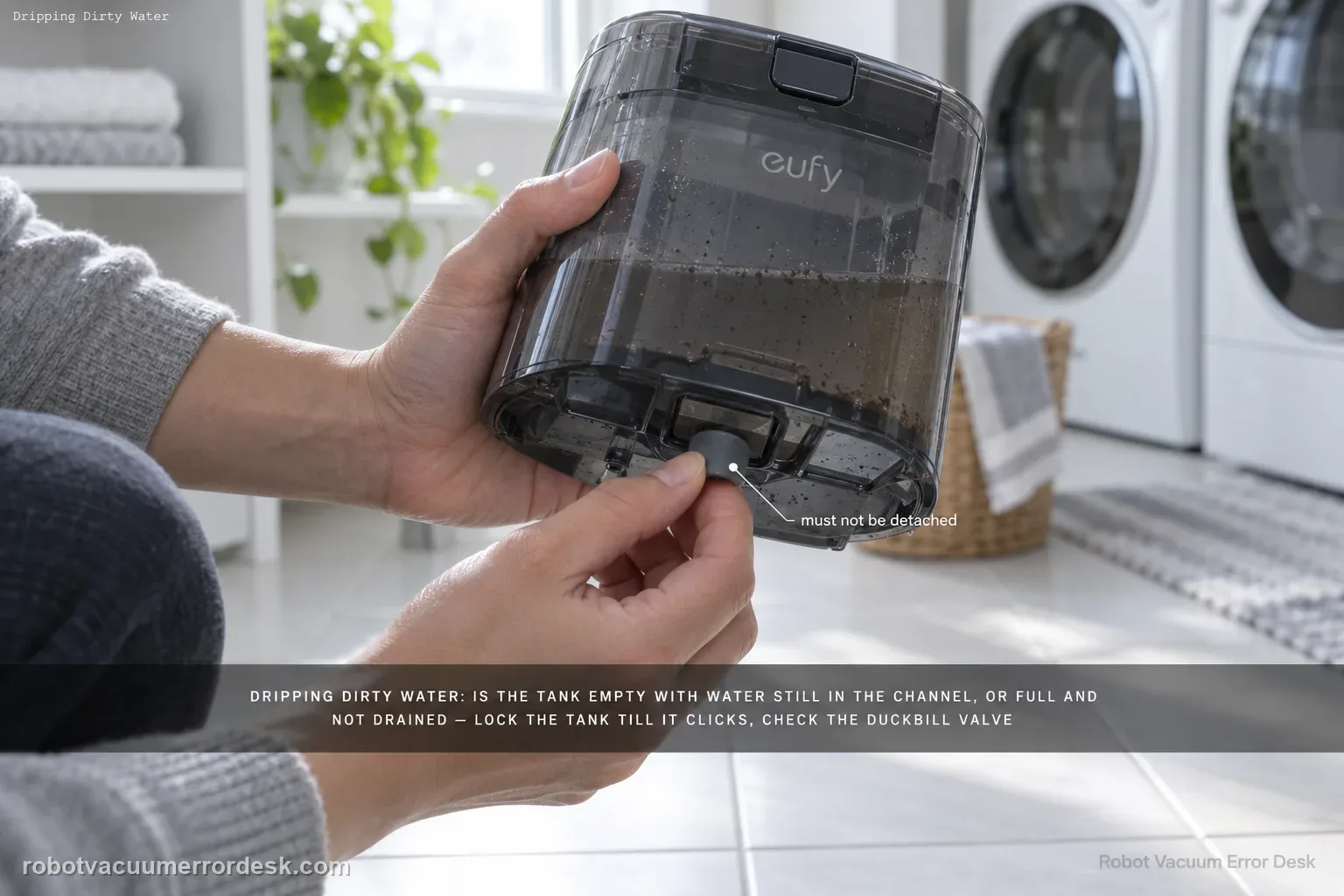
For an E28 that drips dirty water, eufy first separates an empty dirty-water tank with water still in the drain channel from a full tank that the station failed to drain. Then lock the tank until it clicks, remove any Portable Deep Cleaner foam pad, inspect the dirty-water-tank duckbill valve for detachment, and check the tank-to-roller-mop contact area. If water flows correctly down the tank base, eufy says a worn roller mop or excessive water-output setting becomes the next discriminator.
What does the E28 dirty-water path show before the drip?
Confirm the exact model and exact code, light pattern or symptom.
Run the lowest-risk physical or software check first.
Use each pass condition to decide what the result actually narrows down.
Is this the problem you’re seeing?
- Dirty water drips or refluxes around the E28 roller-mop/dirty-water path.
- The dirty-water tank may be unexpectedly empty or full while water remains elsewhere in the channel/trough.
- The symptom is leakage/reflux during cleaning, not the separate audible Wastewater Extraction Error stop condition.
Likely root causes, ranked
Dirty-water tank/channel blockage
Dirty-water tank is not fully latched into the base station
Protective foam interferes with the Portable Deep Cleaner/base interface
Duckbill valve is loose or detached, allowing dirty-water reflux
Roller mop is worn, water output is too high, or debris is obstructing the tank-to-mop contact area
What the result narrows down
| What you observe | What it narrows down | Next move |
|---|---|---|
| Dirty-water tank is empty while water remains in the drain channel | eufy says a blockage may be preventing wastewater from reaching the tank. | Clean the dirty-water tank/channel thoroughly before testing seals or water-output settings. |
| Dirty-water tank is full and not draining normally | The station-side drain/seating path is the stronger branch. | Reseat the tank until the latch clicks and confirm the PDC interface is free of shipping foam. |
| Duckbill valve is loose or detached | The non-return path can allow dirty water to reflux into the trough. | Stop the proof cycle and use eufy's support/part path rather than gluing or modifying the valve. |
| Tank-base flow is normal but dripping persists | With the drainage path open, roller-mop wear or excessive water output becomes more plausible. | Inspect mop wear and reduce water output one level for one controlled comparison. |
| Fresh water appears outside the intended channel during the proof test | The symptom is now a confirmed leak location rather than general dampness. | Stop repeated wet operation, record the leak path and escalate before water reaches electrical areas. |
Do not factory-reset by default. Use the exact model’s reboot/network-reset procedure only when the manufacturer path calls for it.
Checks to run, in sequence
Classify the tank state before changing parts
Remove the dirty-water tank and compare the tank with the dirty-water sink/drain channel. If the tank is empty while water remains in the channel, eufy says a blockage may be preventing dirty water from entering the tank; clean the tank thoroughly. If the tank is full, treat the next checks as a failed-drain/seating path instead of a low-water problem.
Seat the dirty-water tank until the latch clicks
Reinstall the dirty-water tank completely in the base station. eufy says a correctly locked tank should produce a clicking sound. Do not rely only on visual alignment: a tank that looks installed but is not latched can break the intended wastewater path.
Remove any PDC foam interference
Inspect between the Portable Deep Cleaner and base station for the protective foam pad referenced by eufy. Remove it if still present and reseat the removable cleaner/tank. This is the same installation item that can upset the E28 wet-system air path, but here the diagnostic target is visible dirty-water dripping rather than an error-code stop.
Inspect the dirty-water-tank duckbill valve
Check the duckbill valve in the dirty-water tank. eufy shows that a loose or detached duckbill valve can allow dirty water to reflux into the trough and overflow during operation. If the valve is visibly detached or damaged, document it and use the manufacturer’s support/part path rather than improvising a seal repair.
Check downward tank-base flow, then separate mop wear from water output
With the tank removed as directed, observe whether dirty water can flow downward along the tank base. If that path is normal, eufy says the roller mop may be worn or the water-output setting may be too high. Inspect the roller mop for wear and reduce water output one level for a controlled comparison instead of changing multiple settings at once.
Clean the tank-to-mop contact area and run one proof test
Remove debris from the contact areas between the dirty-water tank and roller mop because buildup can hinder roller movement and cause dirty-water leakage. Reassemble, dry the surrounding area and run one short wet-cleaning test. Stop if a fresh puddle forms outside the intended channel.
Escalate if the tank/channel are clean, the tank latches with the expected click, PDC foam is removed, the duckbill valve is secure and the tank-to-mop area is clean but dirty water still drips. Include photos of the duckbill valve and a video showing the leak location. Stop repeated wet operation if water reaches the floor or electrical areas; do not glue, clamp or modify the valve/seals without manufacturer direction.
Information to have ready for support
Support can skip the basic troubleshooting script when you provide a reproducible case. That keeps the results of your checks from getting lost.
- Exact model name and the error code / voice prompt exactly as shown
- A photo or screenshot of the app error and the time it occurred
- A short list of the checks already completed and what happened after each one
- Device information / activity-log details from eufy Clean when the issue is mapping or routing related
Source and evidence level
eufy Omni E28 — dripping dirty water
eufy’s exact E28 dirty-water-drip path distinguishes tank/channel state, confirms tank latch, removes PDC foam interference, checks a duckbill valve for reflux, verifies tank-base flow, considers roller-mop wear/water output and cleans the tank-to-mop contact area.
Additional official source: eufy Robot Vacuum Omni E28 User Guide (T2352) ↗Last editorial review: September 5, 2026Regional note: manufacturer help centers, model suffixes, mains-power requirements and warranty procedures can differ by country. If the source redirects to a local support site, confirm that the model/hardware scope still matches before following a region-sensitive step.
This guide is rated Official model support. See what each evidence label means →
Common questions
How is dirty-water dripping different from Wastewater Extraction Error?
Dripping is a visible leak/reflux symptom. The extraction-error page is an audible stop condition centered on air leakage and failed wastewater removal. Use the page that matches the observed symptom first.
Why is the duckbill valve important?
eufy says a loose or detached duckbill valve can let dirty water flow back into the trough and spill during operation.
Should I reduce water output immediately?
Only after the tank-base flow is normal and obvious blockage/seating/valve issues are excluded. That keeps the test useful instead of masking a drainage fault.
What does an empty dirty-water tank with water still in the channel tell me?
That pattern points toward a transfer blockage rather than simply a full tank. eufy's E28 dripping-water flow tells owners to inspect and clean the dirty-water tank when wastewater remains in the drainage channel instead of reaching the tank, so solve that path before experimenting with mop-water settings.
Should I glue a loose E28 duckbill valve back in place?
No. A detached or damaged duckbill valve is part of the wastewater-control path. Photograph its condition and use the manufacturer support or replacement path rather than adding adhesive, clamps or an improvised seal that could change how the tank vents and drains.
Did this diagnostic narrow the fault?
Use this as an editorial signal, not a popularity counter. If a feedback address is configured you can email the note; otherwise you can copy it for your own support record.