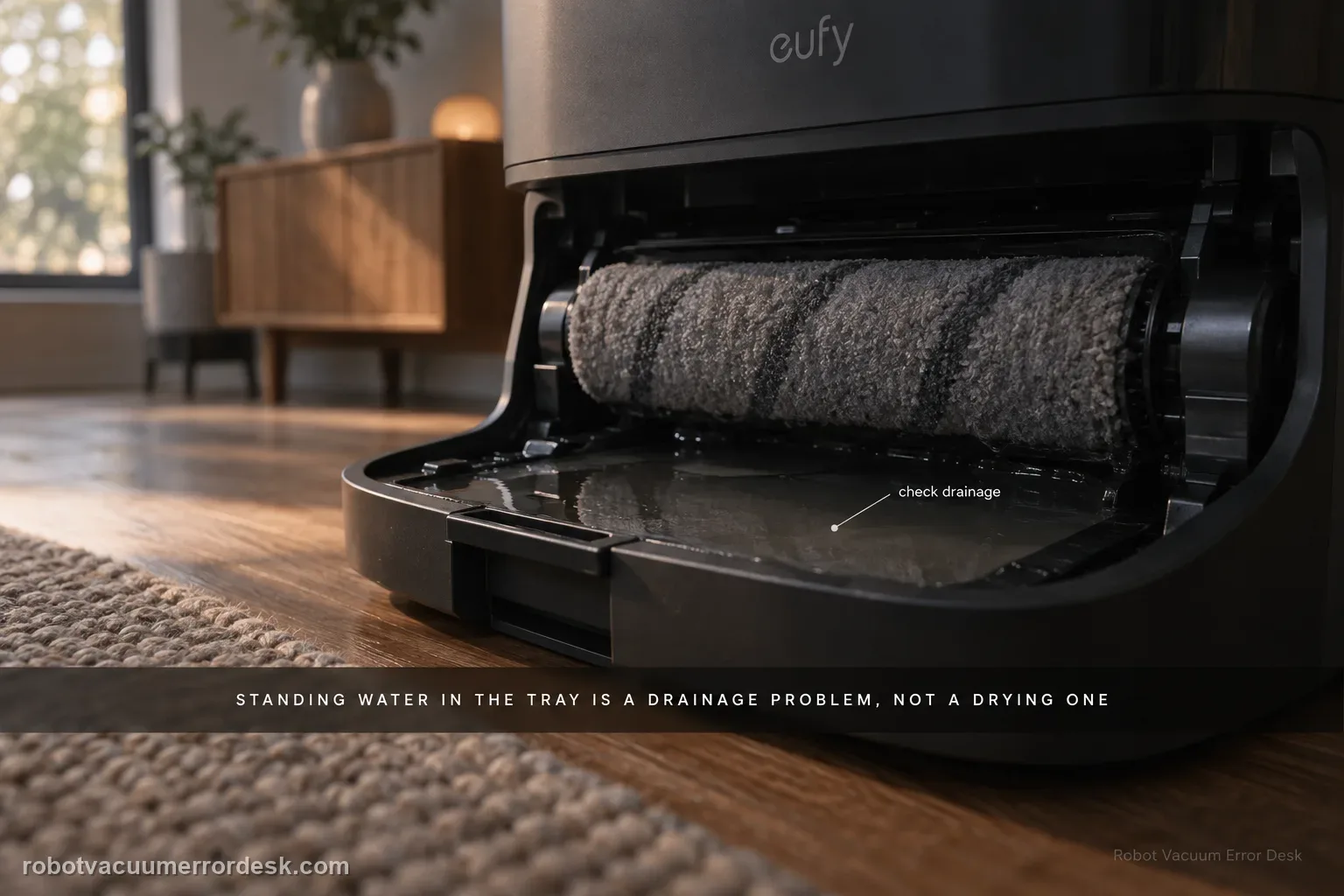
For an eufy E28 roller mop that stays damp, first separate a wet-tray/drainage problem from a true drying problem. eufy says standing water in the cleaning tray can indicate a drainage issue that leaves excessive moisture in the roller. If the tray is draining normally, identify the selected drying mode: the station defaults to Adaptive Drying, while eufy recommends Standard Drying when high humidity prevents complete drying. The exact E25/E28 guidance also gives useful timing baselines—Standard Dry is 5 hours and Quick Dry is 3.5 hours. Run a complete cycle without interruption and evaluate the roller only at the end. A roller that remains clearly wet after a full 5-hour Standard Dry cycle with a normally drained tray is much stronger evidence of a station drying problem than dampness after an abbreviated Quick Dry cycle.
Is the E28 mop damp because of drainage, humidity, or drying-mode duration?
Confirm the exact model and exact code, light pattern or symptom.
Run the lowest-risk physical or software check first.
Use each pass condition to decide what the result actually narrows down.
Does this match your problem?
- The E28 roller mop is still damp after the base finishes drying.
- The problem is worse in humid weather or a poorly ventilated room.
- Standing water is visible in the cleaning tray after self-cleaning.
- Quick Dry completes but the roller remains noticeably wet or develops odor.
Most likely causes
Standing water in the cleaning tray is keeping the roller excessively wet before drying begins
Adaptive Drying is not sufficient for the current ambient humidity
Quick Dry 3.5-hour mode is too short for the environment
The full Standard Dry 5-hour cycle is being interrupted or judged early
The station drying system remains abnormal after drainage, mode and timing are controlled
What your test result means
| What you observe | What it narrows down | Next move |
|---|---|---|
| Standing water remains in cleaning tray | The roller may be entering drying with abnormal excess moisture. | Diagnose drainage/wastewater extraction before judging the drying system. |
| Adaptive Drying is active in high humidity | The default adaptive mode may not fully dry the roller in that environment. | Switch to Standard Drying and complete the full cycle. |
| Quick Dry ends at 3.5 h and roller is damp | The faster mode may be insufficient for current humidity. | Use the documented 5-hour Standard Dry cycle next. |
| Roller dries after full Standard cycle | Drying hardware is functioning under the stronger mode. | Keep Standard mode for similar humidity and monitor tray drainage. |
| Roller stays wet after repeated 5 h Standard cycles with dry tray | Drainage, mode and timing have been largely ruled out. | Escalate to eufy with mode, duration, humidity and tray evidence. |
Do not factory-reset by default. Use the exact model’s reboot/network-reset procedure only when the manufacturer path calls for it.
Run these checks in order
Check the cleaning tray before changing any drying setting
Inspect the tray immediately after self-cleaning. eufy specifically says accumulated water and excessive tray humidity can indicate a drainage-system issue that leaves too much moisture in the roller mop. If the tray is visibly holding abnormal water, do not treat the symptom as a heater or drying-duration problem yet. Fix the wastewater/drainage path first and repeat one self-cleaning cycle. A drying test only becomes meaningful once the roller starts the cycle with the expected amount of residual moisture.
Identify the exact drying mode selected in the app
Open the eufy app and note whether the base is using Adaptive Drying, Standard Dry or Quick Dry. eufy says Adaptive Drying is the default and adjusts drying temperature based on surrounding environmental conditions. Record the current setting before changing it. If you do not know which mode ran, you cannot compare the result against the manufacturer's timing or humidity advice, and it becomes easy to call a deliberately shorter cycle a hardware failure.
Use Standard Drying when the room is humid
If Adaptive Drying leaves the E28 roller damp in a humid environment, switch to Standard Drying as eufy recommends. Keep the station in ordinary indoor conditions with its airflow path unobstructed and allow the complete cycle to finish. Do not add an external heater, hair dryer or improvised airflow source around the dock. The purpose is to test the manufacturer's own drying system under the mode eufy specifically recommends for high-humidity conditions.
Use the 5-hour and 3.5-hour baselines correctly
eufy's E25/E28 timing guidance lists Standard Dry at 5 hours and Quick Dry at 3.5 hours. Quick Dry is intended as a faster option, especially when household humidity is low; it is not a promise that every damp roller should be fully dry in 3.5 hours. If Quick Dry leaves the roller damp, eufy recommends switching back to Standard Dry and drying again. Compare like with like: mode, elapsed time and room humidity should be recorded together.
Let the cycle finish before judging the roller
Avoid opening the station, moving the robot away or stopping drying midway merely to feel the roller. Evaluate the mop only after the selected cycle finishes, and at the same time check whether the cleaning tray stayed normally drained. A damp roller halfway through a 5-hour Standard cycle is not evidence of failed drying. A clearly wet roller after the complete cycle, with no standing tray water and no interruption, is a much stronger and more repeatable signal.
Compare one repeat cycle to rule out a one-off condition
If the first complete Standard Dry cycle is poor, empty wastewater as required, confirm the tray is still draining, and repeat one more full cycle under similar room conditions. Note whether the roller is uniformly damp or only one area remains wet. A repeatable result matters because ambient humidity and the amount of water left after self-cleaning can vary. Two comparable failed Standard cycles are stronger evidence than switching modes several times within one day.
Escalate only after drainage and mode variables are controlled
If the cleaning tray is draining correctly yet the roller remains clearly damp after repeated complete 5-hour Standard Dry cycles, contact eufy with the mode, cycle duration, approximate room humidity, tray condition and photos at cycle completion. Mention whether Quick Dry was tested and whether Standard improved the result. Do not open the station's heater/air path or apply external heat; the controlled observations already isolate the problem more cleanly for manufacturer service.
Escalate when the E28 cleaning tray is draining normally yet the roller remains clearly damp after repeated complete 5-hour Standard Dry cycles in ordinary indoor conditions. Send eufy the selected mode, exact elapsed time, whether Quick Dry was also tried, tray standing-water status, approximate humidity and end-of-cycle photos. If the tray is retaining water, use the drainage/wastewater path instead because the roller may be starting the drying cycle abnormally saturated. Do not open the dock heater or use external heat to force the roller dry.
What to collect before contacting support
Give support a reproducible case instead of “it doesn’t work.” That reduces repeated basic troubleshooting and preserves the clues from your tests.
- Exact model name and the error code / voice prompt exactly as shown
- A photo or screenshot of the app error and the time it occurred
- A short list of the checks already completed and what happened after each one
- Device information / activity-log details from eufy Clean when the issue is mapping or routing related
Manufacturer evidence
eufy E25/E28 — roller mop not drying completely
eufy separates tray/drainage moisture from drying-mode performance, describes Adaptive Drying and recommends Standard Drying in high humidity; a second E25/E28 article documents 5-hour Standard and 3.5-hour Quick Dry.
Additional official source: eufy E25/E28 — roller mop takes too long to dry ↗Additional official source: eufy E25/E28 — odor guidance referencing complete roller drying ↗Last editorial review: September 4, 2026Regional note: manufacturer help centers, model suffixes, mains-power requirements and warranty procedures can differ by country. If the source redirects to a local support site, confirm that the model/hardware scope still matches before following a region-sensitive step.
This guide is rated Official model support. See what each evidence label means →
FAQ
How long should the eufy E28 roller mop take to dry?
eufy's E25/E28 guidance lists Standard Dry at 5 hours and Quick Dry at 3.5 hours. Treat those as mode-specific baselines, not interchangeable promises. Quick Dry is the faster choice for lower-humidity conditions; if the roller remains damp after that cycle, eufy recommends returning to Standard Dry. Judge the roller only after the complete selected cycle, with tray drainage confirmed normal.
Why should I check the cleaning tray if the E28 problem is drying?
Because eufy says accumulated water in the cleaning tray can indicate a drainage-system problem that leaves excessive moisture in the roller mop. A roller that starts drying unusually saturated may stay damp even when the drying system itself is operating. Clear the drainage issue first, then run a fresh self-cleaning and full drying cycle. That separates wastewater extraction from heater/airflow performance.
Is Adaptive Drying supposed to work in very humid rooms?
Adaptive Drying is the default and adjusts drying temperature to environmental conditions, but eufy specifically notes that high humidity can still produce insufficient drying. In that situation, the manufacturer recommends switching to Standard Drying. Run the complete Standard cycle before judging the result. If the tray drains correctly and repeated 5-hour Standard cycles still leave the roller clearly wet, the case is ready for support.
Should I use Quick Dry if my E28 roller mop is already staying damp?
Quick Dry is shorter at about 3.5 hours, so it is not the best escalation when dampness is the complaint in a humid environment. eufy says that if Quick Dry leaves the roller damp, use Standard Dry instead. First confirm the tray is not retaining water, then complete the full 5-hour Standard cycle. That gives a much stronger test of the station's normal drying capability.
When should I contact eufy about an E28 roller mop that will not dry?
Contact eufy when tray drainage is normal and the roller remains clearly damp after repeated complete 5-hour Standard Dry cycles, with no interruption and ordinary station airflow. Provide the selected mode, cycle duration, approximate room humidity, whether Quick Dry was tried and photos of the tray and roller at completion. Those details distinguish a persistent station drying fault from excess starting moisture or an intentionally shorter cycle.
Did this diagnostic narrow the fault?
Use this as an editorial signal, not a popularity counter. If a feedback address is configured you can email the note; otherwise you can copy it for your own support record.