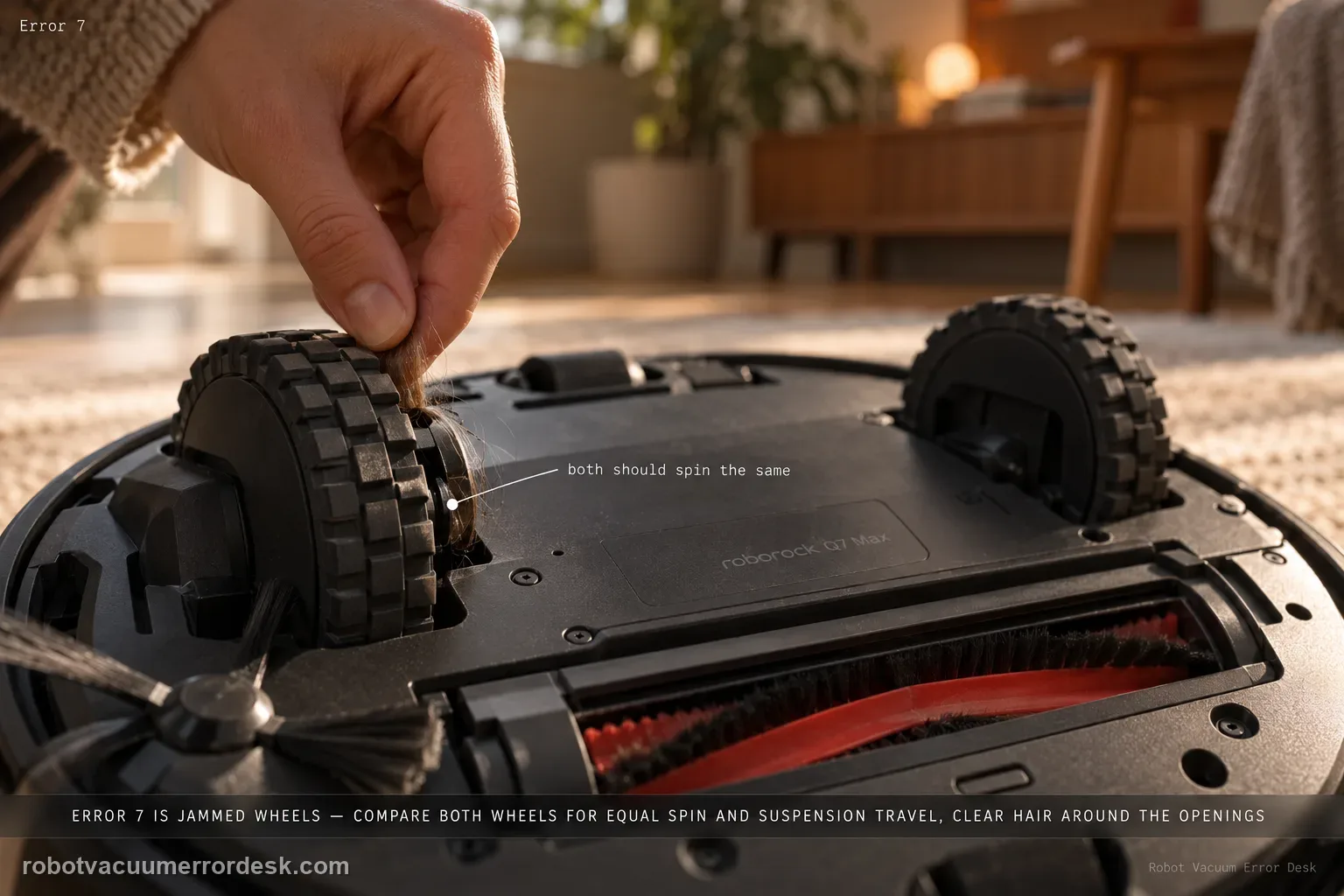
The Q7 Max manual defines Error 7 as “Wheels jammed. Move the robot and restart.” Before restarting, compare the two drive wheels for normal rotation and suspension travel and remove accessible hair or debris around the wheel openings.
Confirm the exact model and exact code, light pattern or symptom.
Run the lowest-risk physical or software check first.
Use each pass condition to decide what the result actually narrows down.
Confirm this is the right issue
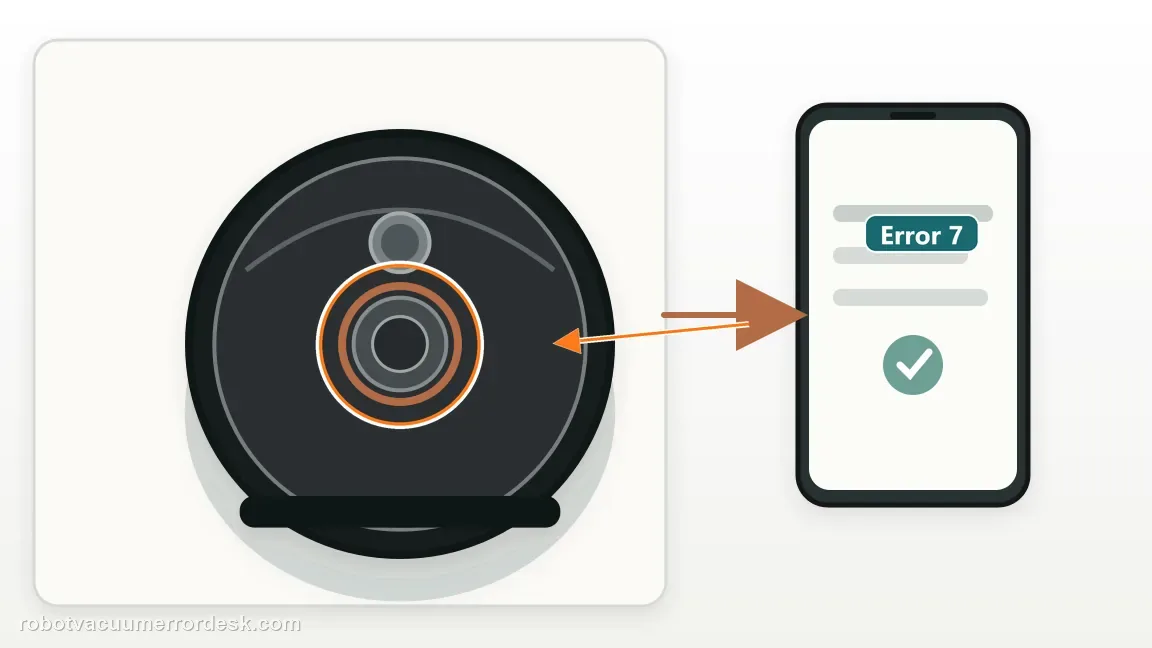
- The Q7 Max reports Error 7.
- The robot drags one side, pivots or stalls soon after starting.
- One wheel feels noticeably stiffer or does not spring through the same travel as the other.
What’s most likely causing this
Hair/thread around a drive-wheel opening or axle area
Debris limiting suspension movement
Robot loaded against a rug edge or threshold
Drive-wheel module fault if the mechanical difference persists
Reading your test result
| What you observe | What it narrows down | Next move |
|---|---|---|
| One drive wheel is difficult to press or rotate by hand | A localized mechanical bind matches Roborock’s Error 7 wheel-jam path. | Remove accessible hair/thread around that wheel and work it only through normal suspension/rotation. |
| Both wheels move freely after debris removal | The obvious jam has been cleared. | Relocate to level open floor and restart as the manual instructs after resolving the error. |
| Error occurs only at one threshold or rug edge | Environment is trapping/loading the drive system rather than a wheel staying jammed everywhere. | Retest on open hard floor and correct the obstacle instead of replacing a wheel. |
| One wheel repeatedly binds again with no visible debris | A deeper wheel/encoder/gear issue is plausible. | Capture the side-to-side difference and contact Roborock; do not open the drive module. |
| Both wheels feel normal but Error 7 returns immediately in open space | External jam evidence is absent. | Record startup/motion behavior and escalate after one restart rather than repeatedly forcing the wheels. |
Do not factory-reset by default. Use the exact model’s reboot/network-reset procedure only when the manufacturer path calls for it.
Work through these checks in order
Confirm Error 7 and move off the original trap
Roborock defines Error 7 as a jammed-wheel condition. Move the Q7 Max to open, level hard flooring before inspecting it so a thick rug, threshold or furniture rail is not still loading the chassis during the test.
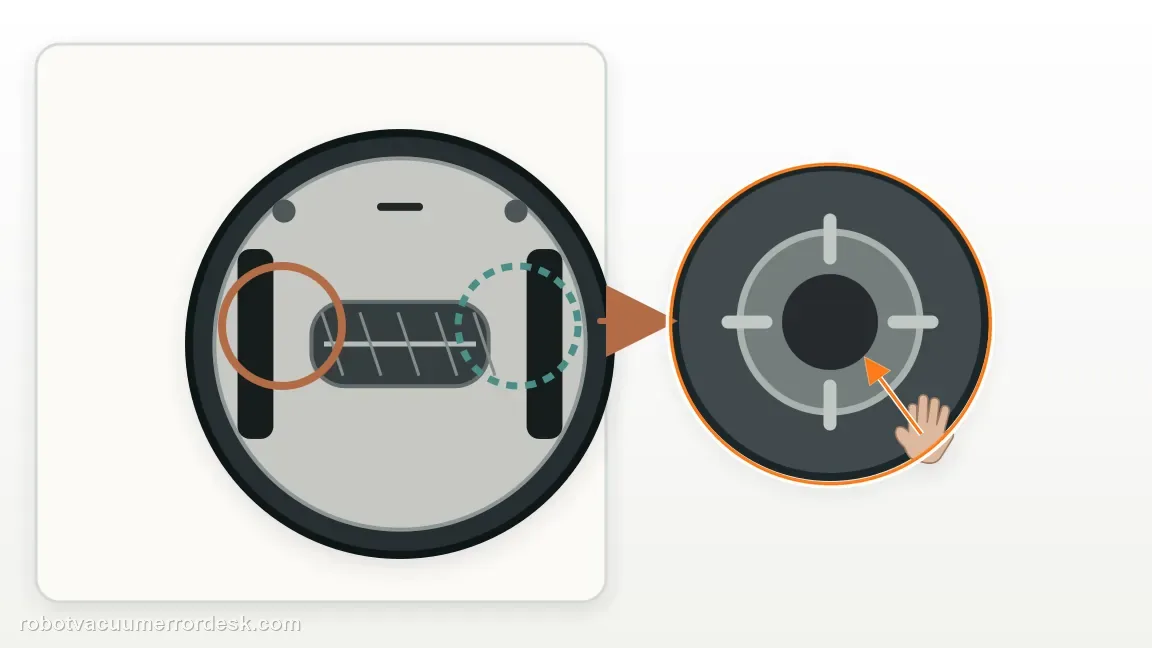
Compare both drive wheels by hand
With the robot stopped, press each drive wheel through its suspension travel and rotate it. Compare left and right resistance, spring return and any hard catch. A clear one-sided difference is more useful evidence than simply saying the wheels look clean. A useful comparison is not only whether a wheel can rotate, but whether both sides feel similar and spring back through their normal suspension travel. If one side is consistently stiffer on clean open floor after visible debris is removed, that repeatable left-versus-right difference is stronger service evidence than the original rug or threshold event. Keep the test gentle and external; the published owner path does not require opening a wheel module.
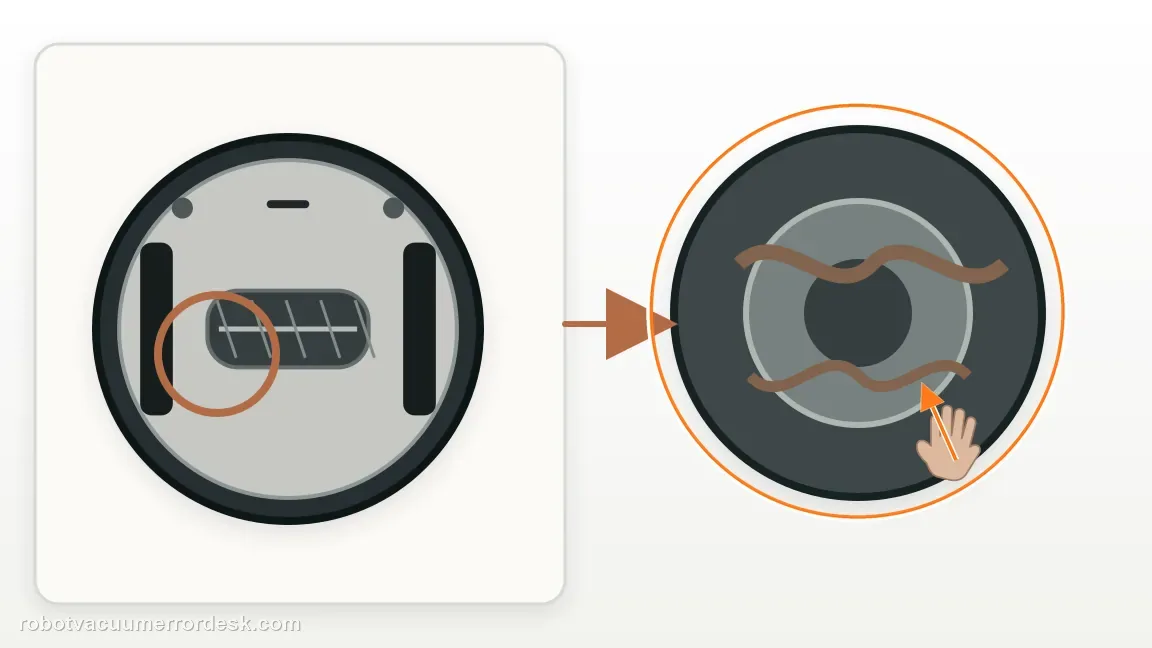
Remove only accessible hair, thread and debris
Pull fibers from the wheel opening and accessible axle area. Recheck movement after each obstruction is removed. Do not pry into, lubricate or open the sealed drive module; the owner-level Roborock path is manual wheel checking and freeing external obstruction.
Run one short open-floor restart
Restart the Q7 Max on the same clear hard floor. Watch whether it can drive straight and turn normally before returning it to rugs or thresholds. If Error 7 clears here, the original environment remains a plausible trigger.
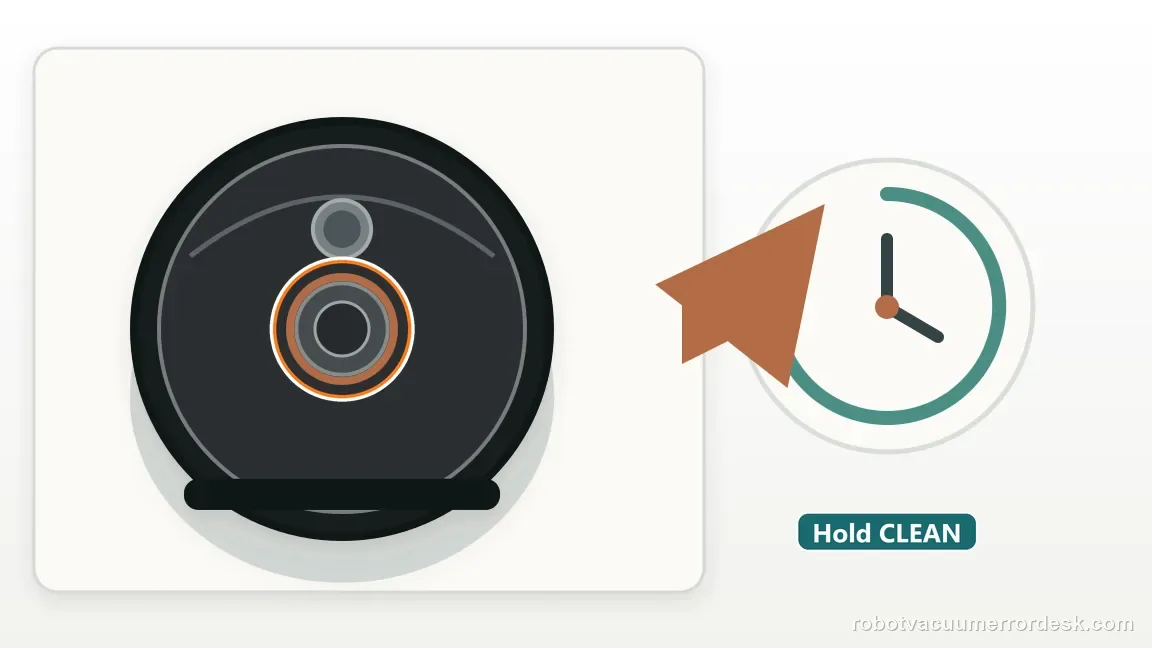
Reintroduce the original rug or threshold only after the control passes
If the robot is normal on open floor, return it to the original transition and observe one controlled pass. A code that follows one thick rug, lip or furniture rail points to environmental wheel loading; correct that area rather than replacing a drive module.
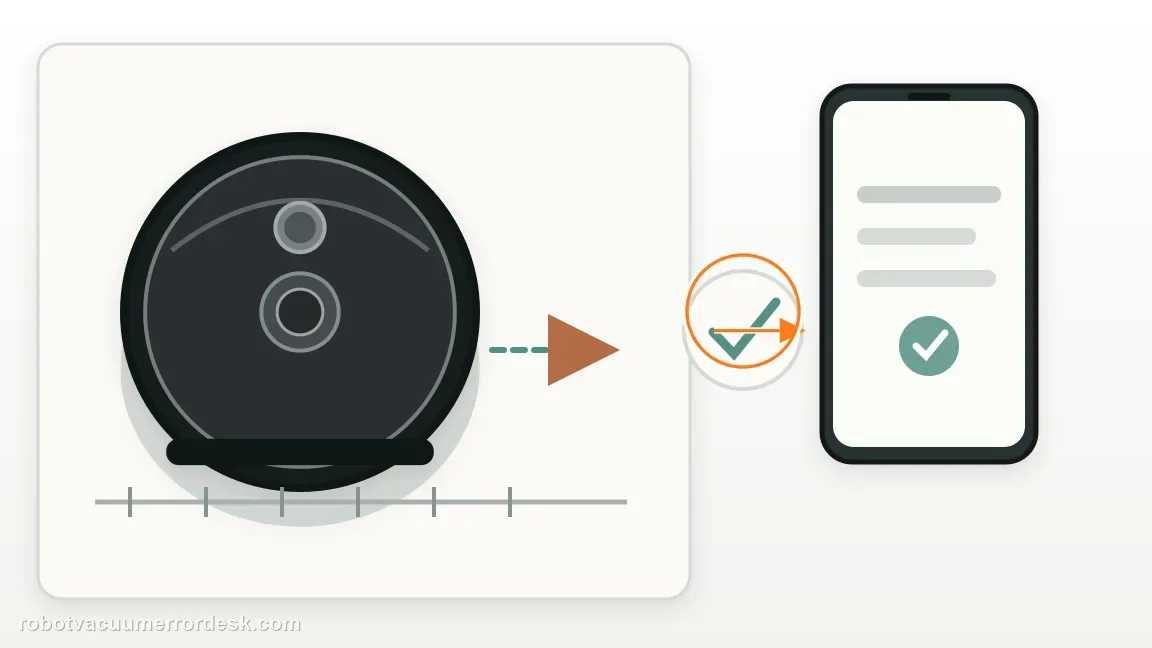
Capture a repeat that follows the robot into open space
If Error 7 returns on clear level flooring after both wheels move freely and visible debris is removed, record the left/right wheel comparison and the restart on video. That repeatable open-floor failure is the point to escalate instead of cycling the same cleaning steps.
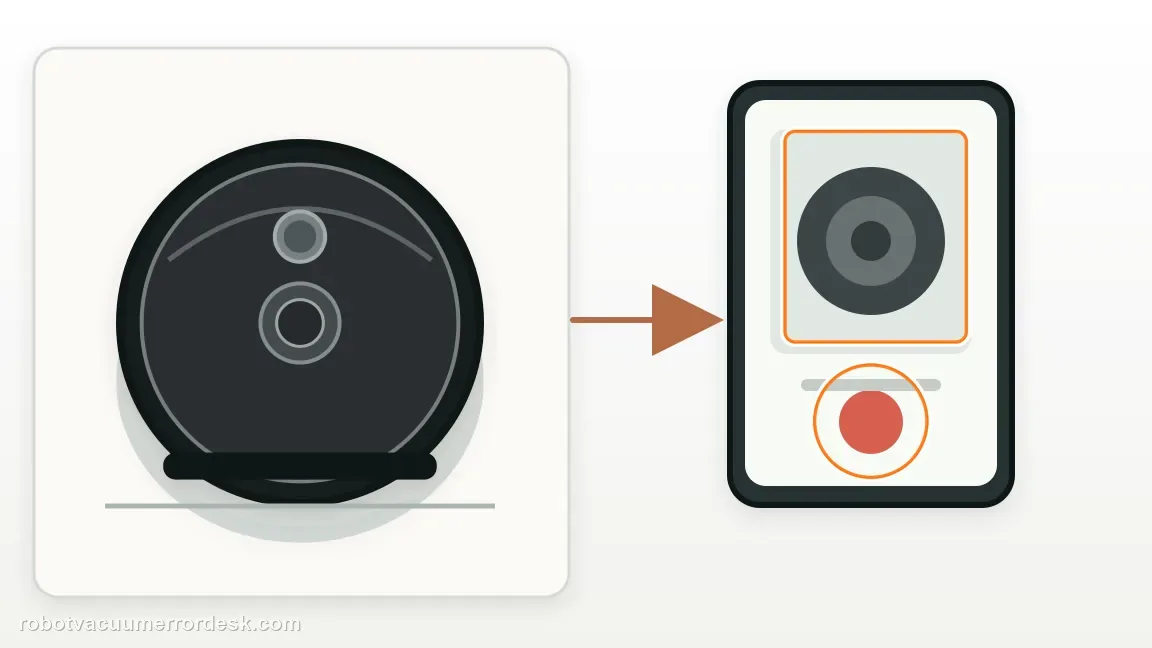
Escalate after accessible debris is removed, both wheels are compared for free rotation/suspension travel and an open-floor restart still reproduces Error 7. Send video of the left/right wheel comparison and the failure. Do not lubricate, pry apart or open the drive module; the published owner procedure ends with manual wheel checking, freeing external obstruction and restart.
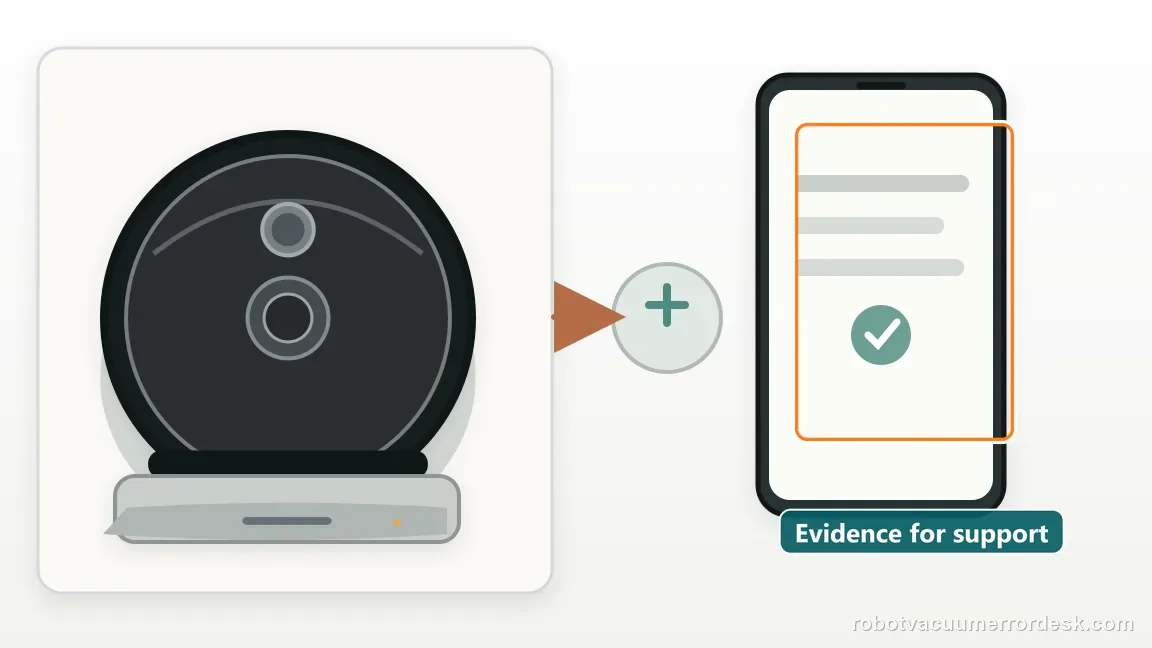
Before you contact support, gather this
A reproducible case moves a support call past the basic troubleshooting script faster than “it doesn’t work” does, and it keeps the clues from your own tests on record.
- Exact model name and the error code / voice prompt exactly as shown
- A photo or screenshot of the app error and the time it occurred
- A short list of the checks already completed and what happened after each one
- Firmware/app version if the issue began after a software change
Where this comes from
Roborock Q7 Max user manual
The exact Q7 Max manual defines Error 7 as jammed wheels and says to move the robot and restart. Roborock’s current Q7 troubleshooting adds the owner check to press and spin the wheels manually, free an accessible jam, then contact support if the error persists.
Additional official source: Roborock — Q7 current troubleshooting hub ↗Additional official source: Roborock — Q7 Max User Manual ↗Last editorial review: September 5, 2026Regional note: manufacturer help centers, model suffixes, mains-power requirements and warranty procedures can differ by country. If the source redirects to a local support site, confirm that the model/hardware scope still matches before following a region-sensitive step.
This guide is rated Official manual. See what each evidence label means →
Questions people ask
What does Error 7 mean on the Roborock Q7 Max?
The Q7 Max manual defines Error 7 as jammed wheels. Roborock’s Q7 support says to press and spin the drive wheels manually, free them if stuck and retry. Compare both sides for resistance and suspension travel, remove accessible hair/thread, then move the robot to open level flooring and restart. If one wheel keeps binding without visible debris, document the asymmetry for support.
How do I check whether a Q7 Max drive wheel is actually jammed?
With the robot stopped, press each drive wheel through its normal suspension travel and rotate it by hand. Roborock uses this as the Error 7 test. Compare left and right: one side that is much harder to rotate or does not spring normally is meaningful. Remove only accessible debris; do not pry into the sealed drive module or force a wheel past a hard stop.
Can a thick rug or threshold cause Q7 Max Error 7?
It can create a wheel-loading or trapping condition that looks like a jam. After cleaning/checking the wheels, retest on open hard floor. If Error 7 clears there and returns only at one threshold or rug edge, correct that environment instead of assuming the wheel module is defective. If it returns in open space with free-moving wheels, the case is stronger for service.
Should I lubricate the Q7 Max drive wheels when Error 7 appears?
No. Roborock’s published owner path is to press/spin the wheels, remove accessible obstruction, relocate and restart. It does not tell owners to add lubricant or open the drive modules. Lubricants can attract debris or reach internal components. If one wheel remains stiff after external cleaning, capture the side-to-side difference and contact support rather than trying to repair the sealed mechanism.
When should I contact Roborock for persistent Q7 Max Error 7?
Escalate when both wheel wells are free of accessible debris, the robot has been moved to open level flooring and Error 7 still returns—especially if one wheel remains noticeably stiffer or has abnormal suspension travel. Send a short video comparing both wheels and the open-floor failure. Do not keep forcing a resistant wheel or open the drive assembly beyond routine external cleaning.
Did this diagnostic narrow the fault?
Use this as an editorial signal, not a popularity counter. If a feedback address is configured you can email the note; otherwise you can copy it for your own support record.