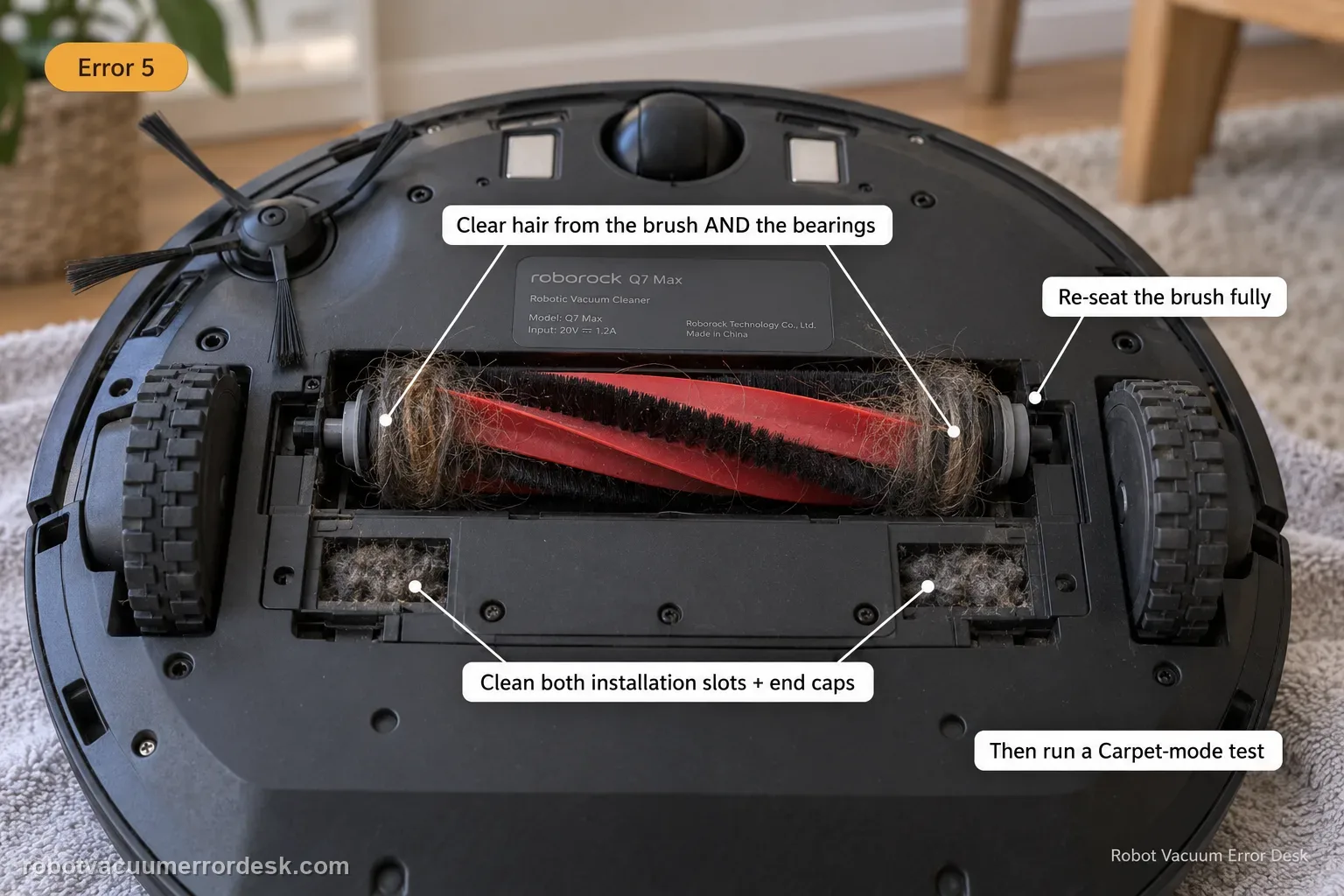
Q7 Max Error 5 means the main brush is jammed. Remove the brush, clear hair from the brush and bearings, clean the two installation slots and both ends, then reinstall it correctly. Roborock’s Q7 support suggests a Carpet-mode test after the tangles are removed.
Confirm the exact model and exact code, light pattern or symptom.
Run the lowest-risk physical or software check first.
Use each pass condition to decide what the result actually narrows down.
Does this match your problem?
- The Q7 Max announces or displays Error 5.
- The main brush stops, clicks or drags during cleaning.
- Hair or fibers may be wound around the brush ends or bearing area.
Most likely causes
Hair/thread is wrapped around the main brush
Debris is packed into the bearings or installation slots
The brush is not correctly re-seated after maintenance
The jam returns even after the user-serviceable brush path is clean
What your test result means
| What you observe | What it narrows down | Next move |
|---|---|---|
| Hair is wrapped around the brush center or end bearings | The manual’s primary Error 5 cause is a mechanical jam. | Remove the brush and clear the body, ends and bearings completely. |
| Brush looks clean but one installation slot is packed with debris | The roller can still bind at its seat even when the visible brush is clean. | Clean both installation slots and end seats before reassembly. |
| Error began immediately after brush maintenance | Incorrect seating or cover fit is more plausible than a new motor fault. | Reinstall the brush/end pieces and latch the cover flush, then verify free movement. |
| Error clears on hard floor but returns on carpet | Load/surface behavior is now the discriminator. | Use Roborock’s Carpet-mode proof test and inspect for renewed hair/fiber pickup from that carpet. |
| Clean correctly seated brush still faults on a short hard-floor run | External jam causes are exhausted. | Stop repeated stall tests and contact Roborock with video/sound rather than forcing the brush drive. |
Do not factory-reset by default. Use the exact model’s reboot/network-reset procedure only when the manufacturer path calls for it.
Run these checks in order
Power off and remove the main brush
Open the main-brush cover using the normal latches and lift the roller out. The Q7 Max manual defines Error 5 as a jammed main brush and identifies the brush and bearings as the first owner-serviceable points.
Clear the roller, both ends and bearings
Remove hair, thread and packed debris from the brush body, both end pieces and bearing areas. A roller can look clean in the center while still binding at one end, so verify the ends rather than stopping after cutting visible hair.
Clean both installation slots
Roborock’s Q7 support specifically says to inspect inside the two brush installation slots as well as both ends. Remove packed debris from those seats before reassembly; do not probe into the drive motor.
Re-seat the brush and cover without pinching the roller
Install the brush fully into its seats and close the cover with the tabs/latches aligned. Gently verify that the cleaned roller is not being pinched by incorrect seating. If the error began immediately after maintenance, this reassembly check is especially important.
Prove basic operation on clean hard floor first
Run a short low-load test on open hard flooring. If Error 5 returns immediately there with a clean, correctly seated roller, the problem is not explained by carpet load and should be documented for support rather than repeatedly forcing the brush.
Then run Roborock’s Carpet-mode comparison
If the hard-floor test passes, use the Roborock-recommended Carpet-mode test on the problem carpet. A failure only on one surface suggests renewed fiber/hair loading or surface-specific brush load; a failure on both hard floor and carpet points away from a simple carpet interaction. Interpret the comparison rather than only checking whether the code appears. If Error 5 clears on hard floor but returns promptly with Carpet mode enabled on a clean, ordinary carpet, preserve that mode-dependent pattern. If it returns even on hard floor with a clean, freely turning brush, the evidence is less consistent with ordinary carpet drag. Either result is more useful than repeatedly removing the same already-clean roller.
Escalate if a clean, correctly seated main brush with clear bearings/end slots still triggers Error 5 on open hard floor. Send photos of the cleaned brush seats and a short video/sound of the failure. Do not force the roller or open the brush-drive motor; the manufacturer’s owner path stops at brush/bearing/slot cleaning, reassembly and a controlled test.
What to collect before contacting support
Give support a reproducible case instead of “it doesn’t work.” That reduces repeated basic troubleshooting and preserves the clues from your tests.
- Exact model name and the error code / voice prompt exactly as shown
- A photo or screenshot of the app error and the time it occurred
- A short list of the checks already completed and what happened after each one
- Firmware/app version if the issue began after a software change
Manufacturer evidence
Roborock Q7 Max User Manual — Error 5
The Q7 Max manual says Error 5 is a jammed main brush and directs owners to clean the main brush and bearings. Current Roborock support adds the two installation slots, both brush ends and a Carpet-mode retest before support escalation.
Additional official source: Roborock — current Error 5 support ↗Additional official source: Roborock — Q7 current troubleshooting hub ↗Last editorial review: September 5, 2026Regional note: manufacturer help centers, model suffixes, mains-power requirements and warranty procedures can differ by country. If the source redirects to a local support site, confirm that the model/hardware scope still matches before following a region-sensitive step.
This guide is rated Official manual. See what each evidence label means →
FAQ
What does Error 5 mean on the Roborock Q7 Max?
The Q7 Max manual defines Error 5 as a jammed main brush and tells owners to clean the brush and bearings. Roborock’s Q7 support adds the two brush installation slots and both brush ends as places to inspect. Remove the roller, clear hair/thread from every end/seat, reinstall it correctly and run a short hard-floor test before the recommended Carpet-mode comparison.
Why does Q7 Max Error 5 return even after I cut hair off the main brush?
Hair around the visible center is only one possible bind point. Roborock specifically says to inspect inside both brush installation slots and at either end of the brush. Debris packed into an end bearing or slot can keep loading the motor after the roller looks clean. Remove the brush again, clear those hidden seats and confirm it turns freely after reassembly.
Can installing the Q7 Max main brush incorrectly cause Error 5?
Yes. If the code began immediately after cleaning, recheck the brush end pieces, seats and cover alignment. A brush can bind when one end is not fully seated or the cover pinches the roller. Reinstall without force and verify smooth hand rotation. If a clean correctly seated roller still stalls on open hard floor, stop repeating the test and contact Roborock.
Why does Roborock suggest testing Carpet mode after Error 5?
The Q7 support page recommends running the robot with Carpet mode enabled after removing tangles. Use that as a second-stage proof test after the brush passes on hard floor. If Error 5 returns only on a particular carpet, inspect for fibers/hair being pulled back into the roller. If it returns everywhere with a clean free brush, the problem is no longer just carpet load.
When should I contact Roborock about Q7 Max Error 5?
Escalate when the main brush body, bearings, both ends and installation slots are clean, the roller is correctly seated and free-moving, yet Error 5 returns on a short hard-floor run. Send a video or sound clip of the stall and photos of the cleaned seats. Do not repeatedly force the brush motor or open the drive assembly; those steps are beyond routine owner maintenance.
Did this diagnostic narrow the fault?
Use this as an editorial signal, not a popularity counter. If a feedback address is configured you can email the note; otherwise you can copy it for your own support record.