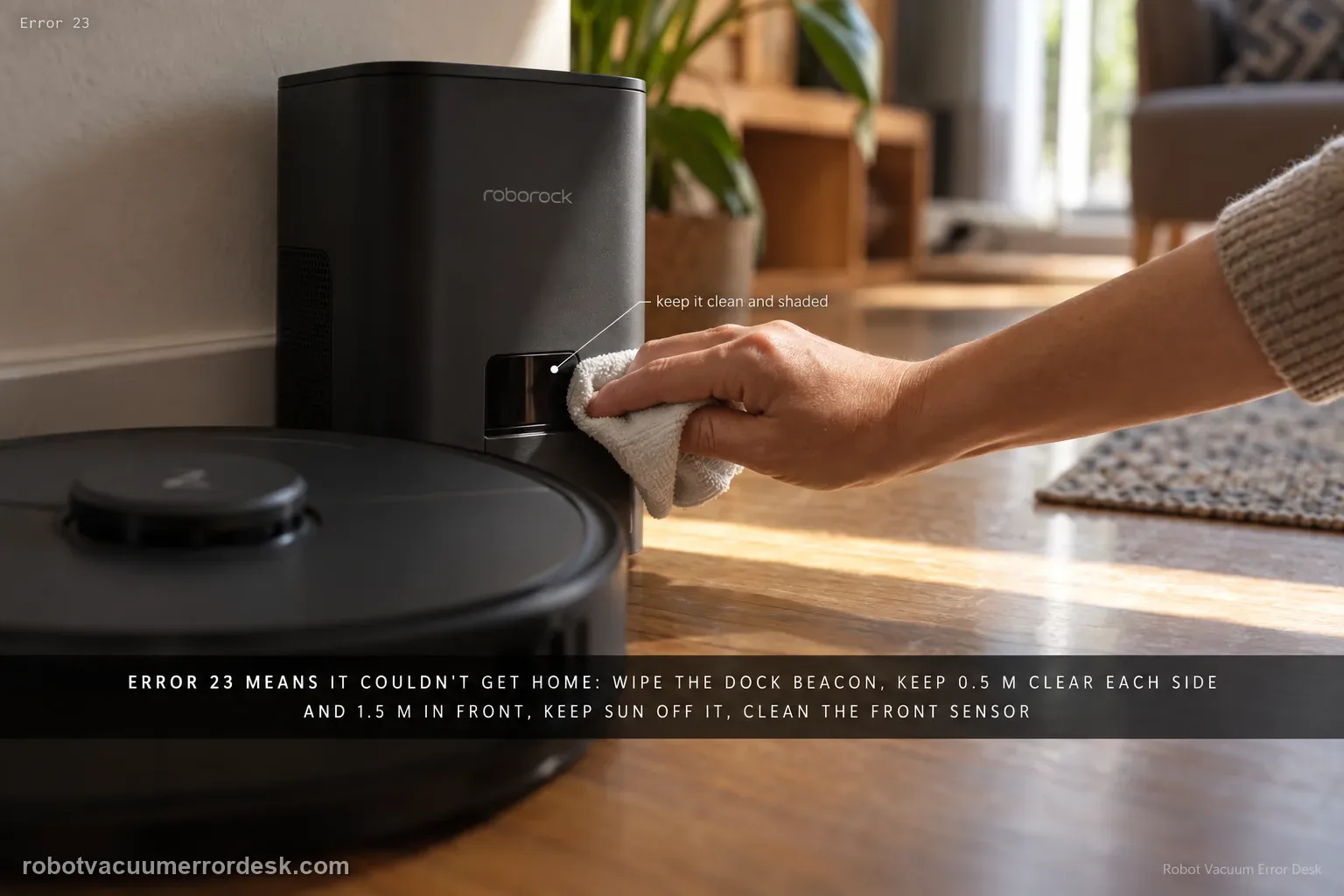
Q7 Max Error 23 means the robot could not return to the dock. The exact manual says to clean the dock location beacon and retry. Also keep at least 0.5 m clear on each side and more than 1.5 m in front, avoid direct sunlight/blocking the beacon, clean the robot’s front sensor and run a short return test before moving the dock again.
Confirm the exact model and exact code, light pattern or symptom.
Run the lowest-risk physical or software check first.
Use each pass condition to decide what the result actually narrows down.
Does this match your problem?
- The Q7 Max announces or displays Error 23.
- The robot finishes or pauses a task but cannot home to the charging dock.
- The dock may be hard to see because of clearance, sunlight, a dirty beacon or front sensor.
Most likely causes
Dock location beacon is dirty or blocked
Dock clearance is below the manual recommendation
Direct sunlight interferes with the beacon area
Robot front sensor is dirty
The robot was started/moved in a way that disrupts the return reference
What your test result means
| What you observe | What it narrows down | Next move |
|---|---|---|
| Dock beacon is dusty or blocked | The manual explicitly names the location beacon for Error 23. | Clean the beacon with a soft dry cloth and remove anything covering the transmission area. |
| Dock has less than about 0.5 m side or 1.5 m front clearance | The final approach geometry is outside the manual recommendation. | Restore clearance before changing maps or moving the station again. |
| Strong direct sunlight hits the dock/beacon | Optical homing can be disrupted by the environment. | Shade/reposition the test so the beacon is not in direct sunlight. |
| Robot front sensor is dirty but dock is clean | Only one side of the homing pair has been serviced. | Clean the robot’s front sensor and run a short nearby return test. |
| Short return still fails under correct beacon/clearance/light conditions | Simple homing-surface and placement causes are exhausted. | Preserve dock position/map and capture the approach behavior before support or any remap decision. |
Do not factory-reset by default. Use the exact model’s reboot/network-reset procedure only when the manufacturer path calls for it.
Run these checks in order
Clean the dock location beacon first
The exact Q7 Max Error 23 table says to clean the dock location beacon and retry. Wipe the beacon area gently with a clean dry cloth so the return test starts with the manufacturer’s first named check completed.
Restore the manual’s dock clearance
Keep at least about 0.5 m clear on each side and more than 1.5 m in front of the dock. Remove cables, furniture and other objects from the final approach lane, and keep the dock fixed for the rest of the test.
Remove strong sunlight and clean the robot’s front homing sensor
The Q7 Max manual warns against direct sunlight or obstruction at the location beacon, and Roborock’s Q7 support also points to the robot’s front sensor used to locate the dock. Clean the front sensor and test under normal indoor lighting.
Run one near-dock Home test without carrying the robot
Start the Q7 Max a short distance in front of the fixed dock on open level flooring, then command Dock. If it cannot locate or align from nearby, keep attention on beacon, sensor, clearance and station environment rather than deleting maps.
Compare that result with a real clean-and-return mission
If nearby homing succeeds, start a normal cleaning task from the dock and let the robot navigate away and return on its own. Do not carry the robot or move the station. A near test that passes while a whole-room return fails makes map/localization context stronger than a local beacon failure.
Separate homing from charging and preserve evidence
Watch the final approach. If the Q7 Max reaches and seats on the dock but does not charge, homing has succeeded and the next guide should be Error 13/contact power, not Error 23. If it still cannot return after the controlled tests, save the approach video and map screenshot for Roborock.
Escalate Error 23 after beacon/front-sensor cleaning, correct side/front clearance, normal lighting and a short return test from a known nearby start still fail. Send the approach video and map screenshot. Do not move the dock or carry the robot during the control run. If the robot reaches the dock but cannot charge, switch to Error 13 rather than continuing homing troubleshooting.
What to collect before contacting support
Give support a reproducible case instead of “it doesn’t work.” That reduces repeated basic troubleshooting and preserves the clues from your tests.
- Exact model name and the error code / voice prompt exactly as shown
- A photo or screenshot of the app error and the time it occurred
- A short list of the checks already completed and what happened after each one
- Firmware/app version if the issue began after a software change
Manufacturer evidence
Roborock Q7 Max User Manual — Error 23
The exact Q7 Max manual defines Error 23 as a failed return to dock and says to clean the dock location beacon. Its installation guidance specifies open approach space and avoiding direct sunlight at the beacon; current Roborock support also separates final homing from other dock problems.
Additional official source: Roborock — Q7 current troubleshooting hub ↗Additional official source: Roborock — general dock-finding guidance ↗Last editorial review: September 5, 2026Regional note: manufacturer help centers, model suffixes, mains-power requirements and warranty procedures can differ by country. If the source redirects to a local support site, confirm that the model/hardware scope still matches before following a region-sensitive step.
This guide is rated Official manual. See what each evidence label means →
FAQ
What does Error 23 mean on the Roborock Q7 Max?
The Q7 Max manual defines Error 23 as “Could not return to dock” and tells owners to clean the dock location beacon. Also restore the manual’s dock clearance—about 0.5 m on each side and more than 1.5 m in front—avoid direct sunlight on the beacon, clean the robot front sensor and run a short nearby return test without moving either device.
How much clearance does the Q7 Max dock need for Error 23 troubleshooting?
Roborock’s Q7 Max manual recommends at least about 0.5 m of open space on either side of the dock and more than 1.5 m in front. Clear cords, furniture edges and other approach obstacles before testing. That geometry is part of the homing environment, so changing maps before the dock has adequate physical approach space can hide a straightforward placement problem.
Can sunlight make the Roborock Q7 Max fail to find its dock?
Yes. The Q7 Max manual warns against direct sunlight at the dock/location beacon because it can interfere with automatic return. Run the Error 23 test under normal indoor lighting with the beacon unobstructed. If the robot returns normally only when strong sunlight is removed, preserve that environmental discriminator rather than relocating the dock repeatedly or rebuilding an otherwise valid map.
Why does my Q7 Max reach the dock but still not charge after Error 23?
Reaching the dock and charging are different stages. Error 23 concerns locating/returning to the dock. If the robot successfully approaches and seats but charging fails, switch to Error 13 and inspect charging contacts, dock indicator behavior and power. That distinction prevents beacon cleaning and remapping from being repeated when the homing phase is already working and the remaining fault is electrical contact.
When should I contact Roborock for Q7 Max Error 23?
Escalate when the dock beacon and robot front sensor are clean, the station has the recommended clearance, direct sunlight/obstruction is removed and a short return test from a known nearby start still fails. Send video of the final approach and a map screenshot. Avoid moving the dock or carrying the robot during the proof run because that changes the homing reference you are trying to evaluate.
Did this diagnostic narrow the fault?
Use this as an editorial signal, not a popularity counter. If a feedback address is configured you can email the note; otherwise you can copy it for your own support record.